When people notice their balance changing, their first instinct is often to practice standing on one leg. That can help, but balance involves much more than holding a position. It requires enough leg strength to control your body, enough mobility to adjust your feet and enough reaction speed to recover when something unexpected happens.
For adults over 45 in Boca Raton and nearby South Florida communities, a complete balance program should combine strength, mobility and practical movement—not simply a collection of wobble-board exercises.
Balance problems are often movement problems
Think about the moments when balance matters: stepping off a curb, walking across uneven ground, carrying groceries, rising from a low chair, turning quickly, climbing stairs or recovering after a trip. Each task requires the body to produce, absorb and redirect force.
If your legs cannot generate enough force, your feet move slowly or your hips cannot control your body as it shifts, remaining upright becomes harder. That is why strength training can improve balance-related function even when the workout does not look like traditional balance training.
New research connects strength with better mobility
A 2026 systematic review examined resistance training in adults age 60 and older with sarcopenic obesity—a clinical combination of excess body fat and impaired muscle mass or function.
Across six randomized trials and 221 participants, resistance training improved Timed Up and Go performance by an average of 2.23 seconds. This test measures how efficiently a person can rise from a chair, walk a short distance, turn and sit back down. Participants also improved on the Short Physical Performance Battery, which evaluates balance, walking speed and chair-rise ability.
The evidence was rated low to very low certainty because only six relatively small trials were available. The findings should be treated as encouraging, not as proof that one program works for everyone.
The scale does not tell the whole story
Many adults begin training with one measurement in mind: body weight. Weight can matter, particularly when fat loss is a goal, but it does not show whether someone can climb stairs more confidently, rise from the floor or carry a suitcase without feeling unstable.
Another recent study followed 126 healthy older adults through a 12-week supervised resistance-based program. Functional performance improved more clearly than muscle capacity, body composition, pain or quality-of-life measures. The study had no nonexercising control group, so it cannot prove training caused every change. It still illustrates something private coaches frequently observe: movement can improve before appearance changes dramatically.
At A2A Fitness, useful progress after 45 can include more controlled chair rises, smoother walking, greater step-up confidence, heavier carries, better posture during turns, fewer hand contacts for support and greater confidence during travel or recreation.
What effective balance training should include
Lower-body strength
Squats to an appropriate target, split squats, step-ups, hinges and calf work develop the force needed to stand, walk and recover. One person may begin with a supported sit-to-stand while another is ready for loaded squats or higher step-ups.
Single-leg control
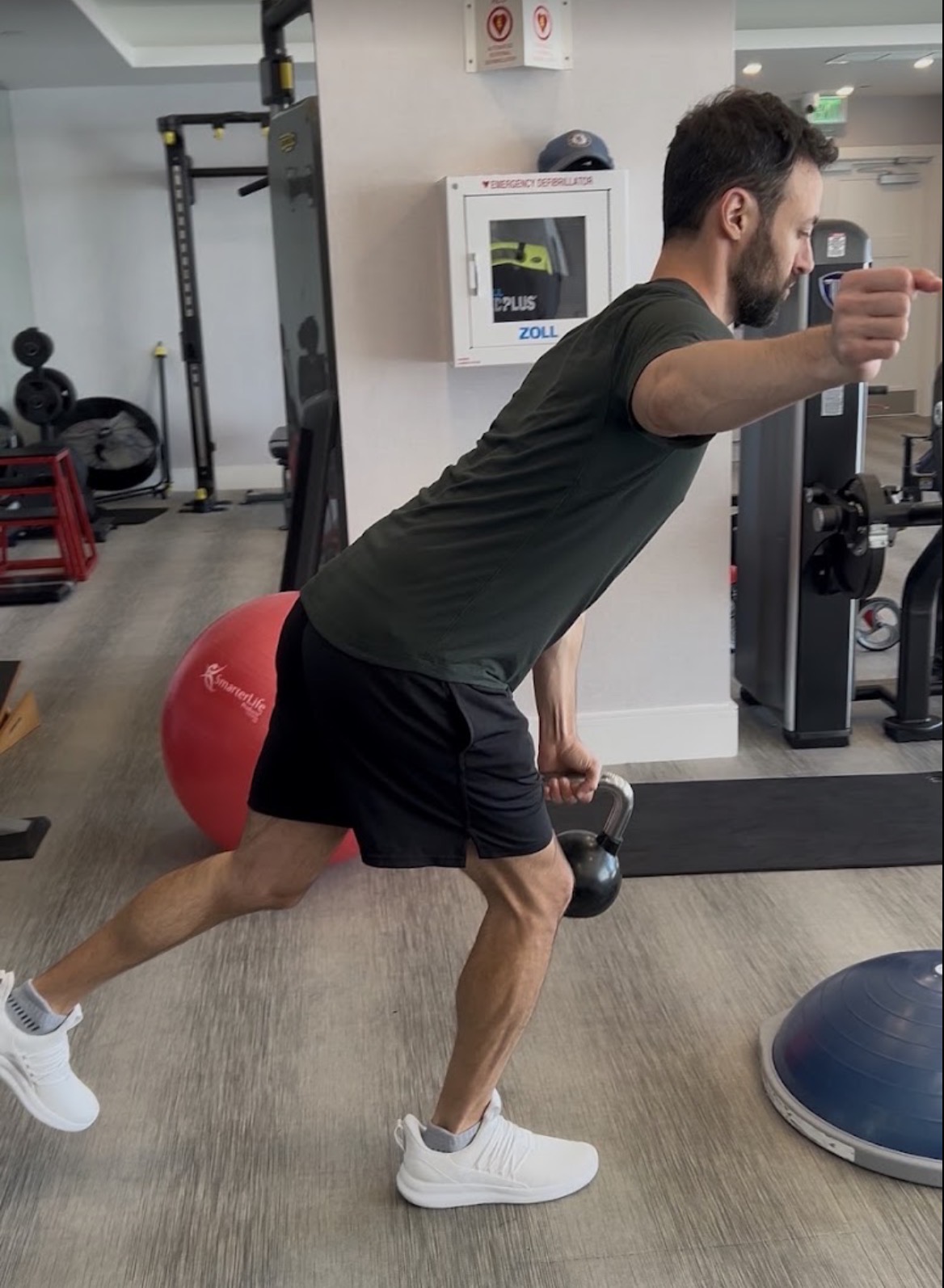
Walking is a repeated transition from one leg to the other. Supported marches, step-ups, split-stance exercises and controlled single-leg work can build stability without creating unnecessary risk. Support is not cheating; it allows the client to practice the correct movement while confidence develops.
Carrying strength
Farmer carries and suitcase carries challenge grip, posture, trunk control and walking mechanics simultaneously. They also transfer directly to groceries, luggage and everyday tasks.
Direction changes
Real life does not happen only in a straight line. Clients should gradually practice controlled turns, side steps, backward steps and changes in walking direction. Precision comes before speed.
Mobility you can control
Having flexibility without control does not guarantee better balance. An ankle may have enough passive range of motion, but the client must still control the knee and foot while stepping or lowering. Mobility work should connect to strength exercises rather than remain completely separate.
Appropriate power
Balance recovery often requires producing force quickly. For capable clients, controlled power can include faster sit-to-stands, purposeful step-ups, medicine-ball work or low-impact directional movement. Power does not automatically mean jumping; it means producing appropriate force with intent and control.
Balance training should feel challenging, not reckless
An exercise is not automatically better because the surface is unstable or the client looks uncomfortable. Advanced-looking drills may add risk without creating a useful stimulus. Most adults can progress using stable surfaces, carefully selected movements and gradual reductions in hand support.
A coach must also distinguish normal effort from warning signs. New dizziness, faintness, unexplained weakness, severe pain, radiating symptoms or sudden coordination changes should not be “trained through.” People with recent falls, neurological conditions, significant neuropathy, recent procedures or cardiovascular symptoms may need guidance from an appropriate healthcare professional.
A simple weekly structure
A practical starting week may include two private full-body strength sessions, brief balance practice three or four days per week, regular walking or another appropriate aerobic activity, ankle and hip mobility, and sufficient recovery between demanding sessions.
Balance practice does not need to last 30 minutes. Five focused minutes performed consistently can be more valuable than one long, exhausting session. For partner training, each person can follow the same movement category while using a different exercise and support level.
Build strength that carries into real life
Rodney Pierre combines more than 15 years of coaching experience with a Sports Medicine background to help adults become stronger, move better and feel athletic again. A2A Fitness private coaching begins with your current abilities—not assumptions based solely on your age or body weight.
Request your private assessment →
Explore Strength & Mobility After 45, senior fitness, one-on-one training, or pain-aware mobility.
Research sources
- Resistance training and balance-related performance in sarcopenic obesity
- Multidomain outcomes following supervised resistance-based exercise
Evidence disclaimer: This article provides general fitness education and does not diagnose or treat medical conditions. Individual needs and responses vary. Anyone with recent falls, new neurological symptoms, cardiovascular symptoms or significant movement limitations should seek appropriate medical guidance before beginning or intensifying exercise.