If you are over 45 and returning to exercise, the amount of advice online can make training feel more complicated than it needs to be. One source says lift every day. Another says aging joints require only light weights. Neither is a useful rule for everyone.
The better answer is personal: use enough resistance to create progress, enough recovery to adapt, and enough mobility and conditioning work to support the life you want. For many adults in Boca Raton, Delray Beach, Deerfield Beach, Highland Beach, Parkland and Coral Springs, that can begin with two focused strength sessions each week.
What the newest research adds
A large 2026 review of 18 randomized trials involving 1,283 adults age 50 and older found that higher-intensity resistance training—defined as at least 70% of one-repetition maximum—produced greater lower-body strength gains than lower-to-moderate intensity work. The review did not find a clear difference in bone mineral density, falls or adverse events between intensity categories. That does not mean every client should immediately lift heavy. It means that, after technique and tolerance are established, continuing to challenge the muscles matters.
A separate 2026 meta-analysis of 13 randomized trials in 546 older adults with sarcopenia found resistance exercise improved grip strength, gait speed, appendicular muscle mass and five-times sit-to-stand performance. The certainty was moderate for most outcomes but low for gait speed because results varied substantially across studies.
The case for progressive resistance training is established. New evidence strengthens the argument that capable adults should not remain permanently in an “easy weight” phase. Intensity is a tool to earn gradually—not a test to pass on day one.
Why two focused sessions are a strong starting point
A major prospective study published in the British Journal of Sports Medicine followed 147,374 adults for up to 30 years. Compared with no resistance training, 90–119 minutes per week was associated with a 13% lower risk of death from any cause, a 19% lower risk of cardiovascular death and a 27% lower risk of neurological disease death, after accounting for aerobic activity. The lowest risks generally plateaued around 120 minutes weekly.
This was observational research, so it cannot prove that strength training caused the lower risk. Training time was also self-reported. Still, repeated activity measures, the very large sample and long follow-up make the result useful when viewed alongside decades of trial evidence showing that resistance training improves strength and function.
For a private coaching client, 90–120 weekly minutes maps neatly to two 45- to 60-minute sessions. A newer randomized trial also found that four minutes of daily functional strength practice improved some functional outcomes in inactive adults 65+ with walking difficulty. That suggests short “movement snacks” may help between coached sessions—but they are a supplement, not a replacement for a progressive full-body program.
What a practical week can look like
Two 30-minute sessions
- 4–5 minutes: warm-up and movement check
- 18–20 minutes: squat or step, hinge, push and pull supersets
- 4–5 minutes: loaded carry, balance or short conditioning finish
- 1–2 minutes: reset and next-session target
Two 60-minute sessions
- 8–10 minutes: mobility, breathing and pattern preparation
- 30–35 minutes: progressive full-body strength work
- 8–10 minutes: power, carries, balance or aerobic intervals
- 5 minutes: targeted mobility and recovery plan
Partner training can use the same structure. One person performs a strength set while the other completes a mobility drill or rests; Rodney adjusts load, range of motion and exercise choice for each person rather than forcing two bodies into one identical workout.
How hard should you train after 45?
Start below your maximum
Early sessions should establish pain-free patterns, control and confidence. Most working sets can finish with roughly two to four good repetitions still available. This provides a meaningful stimulus without turning every session into a recovery problem.
Progress one variable at a time
Add a repetition, a small amount of load, a set, or a little range of motion—not all four at once. Progress should be visible over weeks, while daily readiness, sleep, symptoms and training history guide the pace.
Train useful patterns
A balanced program usually includes a knee-dominant movement, a hip hinge, pushing, pulling, carrying, calf and foot work, trunk control and balance. For athletic adults, appropriately scaled power—such as a quick sit-to-stand, medicine-ball throw or low-impact step pattern—can help preserve the ability to produce force quickly.
Mobility belongs inside the strength plan
Mobility is not just a long stretch at the end. It is the usable range of motion you can control. A client who wants a deeper squat may need ankle or hip mobility, but also strength and confidence in the new range. That is why A2A integrates mobility into warm-ups, strength exercises and between-session practice rather than treating it as a separate cure-all.
Some stiffness is normal, but persistent, severe or radiating pain, unexplained weakness, or symptoms after a recent procedure deserve evaluation and clearance from an appropriate licensed healthcare professional. Personal training can be adapted around many limitations; it does not diagnose or treat medical conditions.
The bottom line for adults 45+
Established evidence supports progressive resistance training for strength and physical function. Promising new work suggests higher intensities can provide an advantage once a client is prepared, and brief daily practice may improve adherence and function. The exact “perfect” intensity, weekly frequency or exercise list is not settled for every person—and no single study should dictate your plan.
The practical target is simpler: start with two coached full-body sessions per week, progress deliberately, include aerobic movement and short mobility practice, and adjust the dose to how your body responds. Consistency plus progression beats occasional heroic workouts.
Build your strongest next chapter in Boca Raton
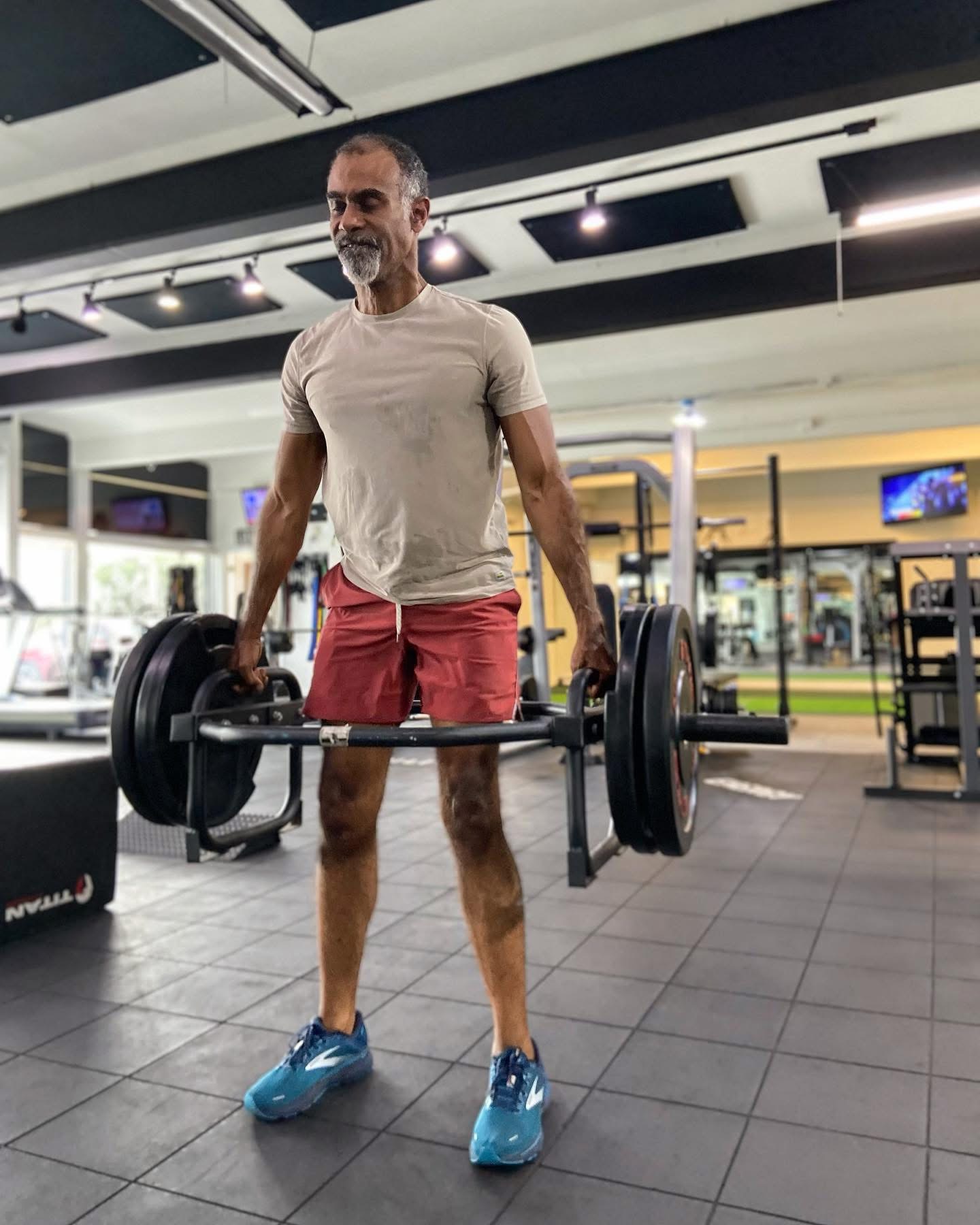
Rodney Pierre brings more than 15 years of coaching experience and a Sports Medicine background to private strength, mobility and longevity coaching at A2A Fitness. Your plan starts with your goals, training history, movement needs and schedule—not a generic age-based workout.
Request your private assessment →
Explore Strength & Mobility After 45, one-on-one coaching, partner training, mobility and stretching, or senior fitness coaching.
Research sources
- 2026 systematic review and meta-analysis: high- versus lower-intensity resistance training in older adults
- 2026 meta-analysis: resistance exercise for older adults with sarcopenia
- 2026 prospective cohort: resistance training dose and mortality
- 2026 randomized trial: brief daily functional strength training
Evidence disclaimer: This article is educational and does not provide medical diagnosis or treatment. Research findings describe groups and may not predict an individual response. Training should be individualized, and medical clearance may be appropriate for significant symptoms, unstable conditions or recent procedures.